
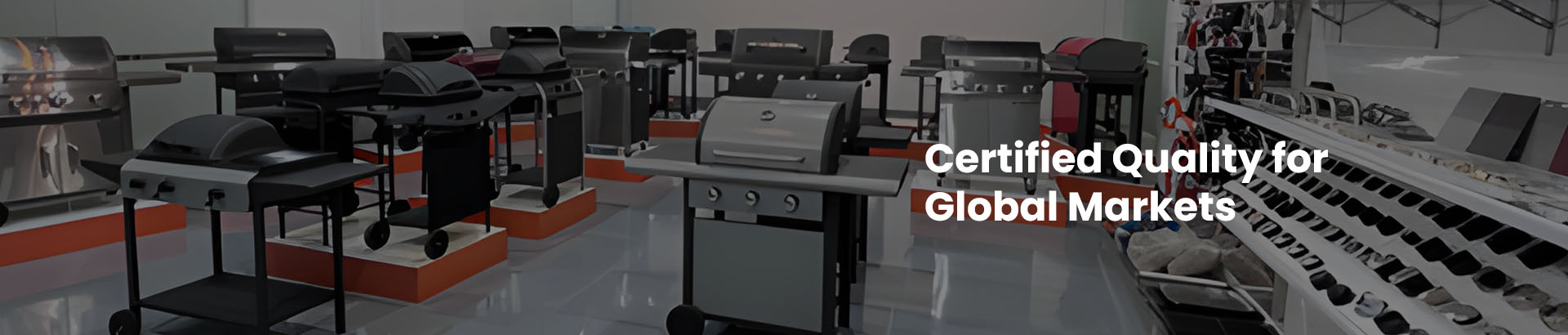
Commercial buyers evaluate outdoor cooking equipment very differently from retail consumers. Their focus is not only on appearance or price, but on durability, operational efficiency, compliance, and long-term supply reliability. When sourcing gas grills, charcoal grills, or Plancha systems for hospitality, catering, or large distribution programs, buyers prioritize features that reduce operational risk and support scalable procurement.
Below are the most valued features from a professional sourcing perspective.
1. Structural Durability and Material Standards
Durability is the foundation of commercial purchasing decisions. Outdoor cooking equipment used in high-frequency environments must withstand heat stress, weather exposure, and repeated transport.
Key material expectations include:
Heavy-gauge steel construction
Corrosion-resistant coatings
High-temperature resistant finishes
Stainless steel components for food-contact areas
Commercial buyers typically request documented material specifications and thickness standards. Manufacturers that control stamping, welding, and surface treatment in-house can guarantee consistency across bulk production runs.
2. High-Performance Burner Systems
Performance stability is essential in commercial settings. Buyers prioritize:
Even heat distribution
Reliable ignition systems
Stable gas pressure regulation
Adjustable heat zones
Gas leak testing, burner calibration, and flame consistency inspection must be part of the factory’s quality control process. Equipment that demonstrates stable output under extended use cycles is highly valued in catering and hospitality operations.
3. Ease of Assembly and Maintenance
Commercial environments demand quick setup and simplified servicing.
Valued structural features include:
Modular assembly design
Standardized fasteners
Accessible burner replacement
Removable grease trays
Ease of maintenance reduces downtime and after-sales costs. A manufacturer with integrated engineering capability can refine structural design based on buyer feedback during OEM/ODM projects.
4. Certification and Export Compliance
Compliance is non-negotiable in international trade. Commercial buyers require equipment aligned with regional regulations such as:
Gas appliance safety standards
Food-contact material certifications
Labeling and packaging compliance
Factories experienced in exporting to multiple regions integrate compliance documentation into production planning, preventing delays during customs clearance.
5. Bulk Supply Stability and Production Capacity
Supply continuity is critical for commercial programs and retail chains.
Buyers evaluate:
Factory production area and capacity
Seasonal peak handling ability
Lead time stability
Inventory planning systems
A manufacturer with structured production planning and multi-line assembly capability can scale output during seasonal demand spikes without compromising quality.
6. OEM / ODM Flexibility
Customization is highly valued in commercial procurement. Buyers often require:
Private labeling
Structural adjustments
Packaging modifications
Market-specific certification updates
An established OEM/ODM workflow reduces development cycles and tooling redundancy. Modular platform design lowers long-term cost per unit while allowing differentiated product lines.
7. Container Optimization and Freight Efficiency
Outdoor cooking equipment is bulky. Commercial buyers analyze:
Knock-down packaging structure
Container loading quantity
Carton reinforcement standards
Optimized packaging reduces freight cost per unit, improving total landed cost. Manufacturers who engineer packaging alongside product structure provide measurable logistics advantages.
8. Quality Control Transparency
Professional buyers expect documented inspection procedures.
Important checkpoints include:
Leak testing reports
Structural load testing
Surface coating adhesion checks
Pre-shipment inspection records
Integrated quality systems reduce defect rates and warranty claims, protecting long-term commercial relationships.
Conclusion
Commercial buyers of outdoor cooking equipment prioritize durability, burner performance, compliance, ease of maintenance, scalable production capacity, OEM flexibility, logistics efficiency, and transparent quality control.
A factory-based manufacturer with integrated production processes, documented material standards, structured quality checkpoints, and stable export compliance systems is best positioned to meet these expectations while supporting large-scale international supply programs.