
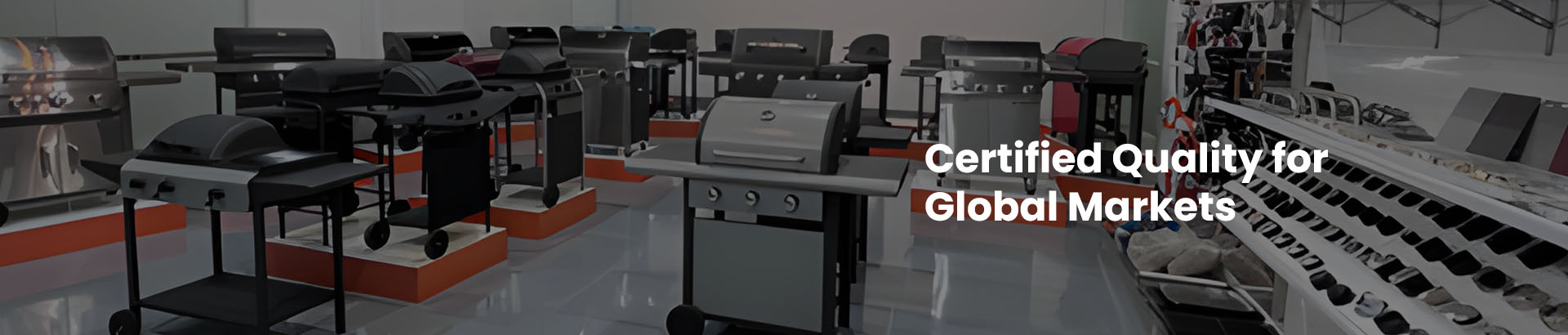
Outdoor grill pricing in international trade is shaped by material inputs, manufacturing structure, compliance requirements, logistics factors, and supplier business models. Understanding these cost drivers helps buyers evaluate total procurement value rather than focusing only on unit price.
Raw Materials and Component Standards
Steel and stainless steel account for a large portion of grill cost. Thicker gauge materials, higher corrosion-resistant grades, and food-contact certified components increase raw material expenses but improve durability and compliance performance.
Key cost variables include:
Steel thickness
Stainless steel grade selection
Cast iron vs coated grates
Burner system material quality
Manufacturers with stable bulk purchasing systems can control raw material fluctuations more effectively than traders sourcing per order.
Manufacturer vs Trader Structure
Factory-direct manufacturers control stamping, welding, coating, and assembly in-house. This reduces layered markups and stabilizes pricing during peak seasons.
Traders often add margins and rely on third-party capacity, which can lead to price volatility during seasonal demand spikes. Direct manufacturing allows:
Predictable lead times
Stable MOQ structures
Transparent cost breakdown
This structural efficiency directly impacts export pricing competitiveness.
OEM / ODM Development Costs
Customization affects pricing through:
Tooling and mold investment
Engineering adjustments
Packaging redesign
Certification updates
Manufacturers using modular design platforms reduce tooling redundancy and shorten development cycles, helping control long-term per-unit costs.
Manufacturing and Quality Control
Outdoor grill production involves stamping, welding, surface treatment, burner assembly, and gas tightness testing. Gas models require additional safety checks, increasing labor and inspection costs.
Quality control checkpoints such as:
Leak testing
Coating adhesion testing
Structural load inspection
add operational cost but reduce warranty risk and export claims.
Certification and Export Compliance
Different markets require CE safety approvals, food-contact compliance documentation, and labeling standards. Certification testing, documentation preparation, and periodic renewals contribute to total cost.
Experienced manufacturers integrate compliance processes into production planning, minimizing delays and duplication expenses.
Logistics and Container Efficiency
Outdoor grills are bulky products. Packaging structure, knock-down design, and container loading efficiency strongly influence freight cost per unit.
Optimized carton engineering and consolidated bulk orders reduce international shipping expenses and improve overall pricing.
Conclusion
Outdoor grill pricing in international trade is driven by material standards, production structure, OEM development scope, quality control intensity, compliance requirements, and logistics efficiency.
A factory-based manufacturer with integrated production, structured OEM/ODM capabilities, and export-ready compliance systems delivers stable pricing supported by controlled manufacturing processes and scalable bulk supply capacity.